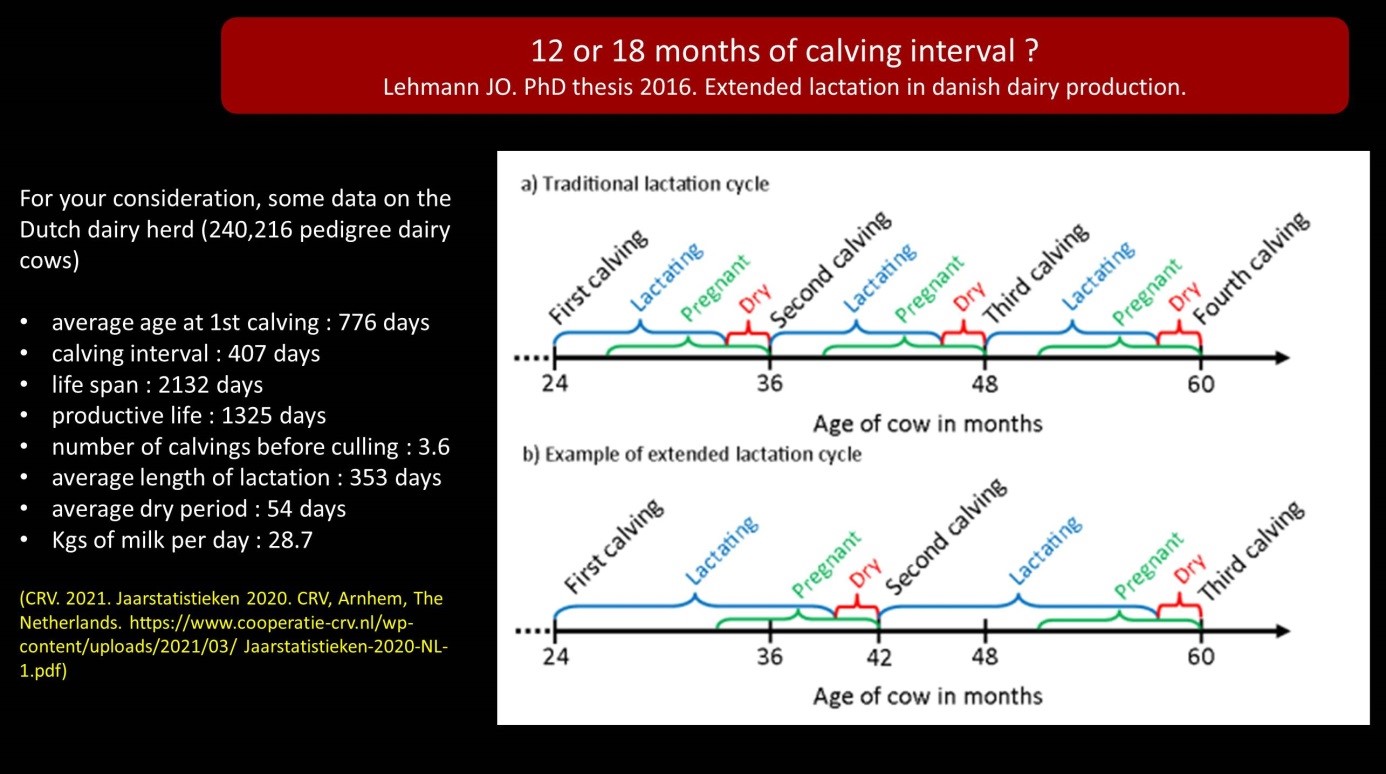
WHAT IF WE VOLUNTARILY EXTENDED THE LENGTH OF LACTATION?
REFERENCE : van Knegsel ATM et al. Extending lactation length: consequences for cow, calf, and farmer. Journal of Animal Science, 2022, 100, 1–10 https://doi.org/10.1093/jas/skac220.
Recent data for the Dutch dairy herd (240,216 pedigree dairy cows) (mean age at 1st calving: 776 days, calving interval: 407 days, life span: 2132 days, productive life span: 1325 days, number of calvings before culling: 3. 6, average duration of lactation : 353 days, average duration of drying off : 54 days, Kgs of milk per day : 28.7) invite us to ask ourselves the question of whether it would not be interesting to lengthen the duration of lactations by and in particular a lengthening of the interval between calving and the moment of the 1st insemination (waiting period : PA). This policy implies to analyze the various positive or negative consequences.
Effects on persistency
In general, an increase in the PA results in a better persistence of milk production in primiparous cows (increase of the average production per day between two calvings) than in multiparous cows (the average milk production decreases). It is true that some studies do not observe an effect of increased BP.
Effects on body condition
An increase in lactation duration following compliance with BPs of 120 to 180 days translates into the risk of an increase in body condition at the end of lactation and of a negative energy balance after calving. Ration adjustment may be necessary.
Effects on health and well-being
In the medium and long term, it is obvious that the extension of the duration of lactation will reduce the number of transition periods, which are known to be at high risk of metabolic and infectious pathologies that lead to an increase in premature culling. However, one of the few studies on the subject observes that the number of treatments performed during these transition periods is less when the waiting period is 50 days than when it is 125 or 200 days.
A longer withdrawal period indirectly contributes to an increase in the cell content of milk at the end of lactation, especially in multiparous cows, but is not related to an increase in clinical mastitis cases. The decrease in milk production at the end of lactation can also contribute to increase the animal’s well-being at the time of drying off because of the decrease in mammary pressure at this time. It may also reduce the risk of new mammary infections after calving.
Effects on reproductive performance
It is known that fertility increases with the length of the waiting period. This improvement reflects the improvement in uterine health (reduction of inflammatory cells) and the regularity of cycles. It is proportional to the degree of lengthening of the waiting period.
Effect on calves
Several studies have demonstrated the possible negative impact of the metabolic status (catabolism > anabolism) of the cow in early gestation on the development of the newborn (developmental programming). A longer lactation period also means fewer births per year (24 fewer calves per 100 cows if the lactation period is extended by 4 months). This results in less time spent by the farmer but also in fewer calves being raised for meat production.
Economic effects
From the different studies carried out, it appears that the extension of the lactation period should concern more the cows with a high dairy potential of the herd than the whole herd, the economic impact of an extension of 2 or even 3 months of the waiting period being strongly dependent on the level of milk production.
Environmental effects
In general, the level of greenhouse gas emissions increases when milk production decreases. A longer lactation period will contribute to reduce this emission, as the number of replacement heifers is reduced due to the increased longevity of the cows. In addition, the longer lactation period will reduce the amount of concentrates needed. Finally, the number of calves born for meat production will also be reduced.
But what to do?
According to different surveys, it seems that the lengthening of the lactation period is due to voluntary causes, as the farmer applies this policy to cows with higher milk production, or to involuntary causes, as the reproduction period is lengthened due to infertility. A selection strategy for these cows is needed and should be evaluated. It would be based on previous lactation production, peak production, early lactation production or body score at calving or even pathologies presented or not during the waiting period.